flickr marketplace
BuildING a licensing program for the world's largest photography community
Director of Curation & Content Strategy | Flickr / Yahoo! | 2014 - 2016
The Objective

OPPORTUNITY
Providing the Flickr community with the ability to monetize their work while creating avenues of engagement.
Flickr was the largest photography community on the internet in 2014, with more than 112M registered members and over 3.5M new images uploaded daily. What the platform lacked were engagement and monetization opportunities in the place where the photographers, artists and designers were already storing, sharing, and interacting with visual work.
The objective was to build a marketplace inside of Flickr that empowered the creative community to monetize and grow awareness for their photography. Running parallel to that mission was a set of programs designed to put this content in front of the people and brands searching for impactful visual moments.
The Work

platform development
Evolving the technical infrastructure of a photo-sharing platform into a licensing marketplace.
The Marketplace required a fully viable CMS stack sitting on top of the existing Flickr codebase, covering curation, moderation, metadata, distribution, and payout, none of which existed when the program was founded.
Tooling and workflows had to be built in parallel with the program itself, which created a sequencing challenge. The problem to be solved was to keep curation, licensing, and community success moving without waiting for the platform to catch up.
Areas of Ownership: Workflow design | Roadmap & feature prioritization | Community and internal team UX | Funding decisions & budget planning

Content design
Designing the language and user flows that transitioned a photographer from invitation to monetization.
Before any photographer could be invited to the Marketplace, the contributor experience had to be designed end to end. Each stage of the flow was a place where a photographer could stall, disengage, or leave the program entirely.
The goal was to design an experience where the content carried as much weight as the interface. Each new button, notification, and submission step had to meld into the existing Flickr platform while guiding the photographer through with as little friction as possible. Focus areas included:
Invitation and opt-in flows.
Status and feedback language across contributor-facing surfaces.
Help and FAQ messaging introduced at the right time and the right place.
Lifecycle and notification messaging covering each stage of the process.
Areas of ownership:Content design | End-to-end user flows | Information architecture | UX writing | Help and support content | Content standards

Visual CURATION
Curating commercially viable, high-quality creative assets from a platform of over 10 billion photos.
Curation was not about finding impactful, high quality content, which was in abundance on Flickr. The challenge was finding creative work that fit commercial opportunities inside a platform built for a different purpose. Focus areas included:
Finding eligible photographers within a community of millions of registered users, including signals that indicated a fit with the opportunity rather than solely surfacing popular work.
Providing invited photographers with enough information to decide whether the opportunity was of interest, rather than optimizing for acceptance rates.
Tracking outreach patterns and lifecycles, ensuring that photographers were not repeatedly approached across curation cycles.
Areas of Ownership: Curation strategy | Collection composition & fit | Contributor outreach & messaging | Lifecycle tracking


LEGAL COMPLIANCE
Creating the legal documentation, FAQs, and communication patterns that established legal compliance for every asset.
Before a single photographer could be invited into the program, the legal infrastructure had to be in place. This included Contributor Terms of Service with an opt-in flow, documentation of the rights to be granted written in language a photographer could actually parse, model releases and property releases, and workflows to support documentation compliance. The harder problem was building infrastructure that could ingest contributor opt-in motions at volume and store release documentation that would hold up under audit.
Once that structure existed, every asset was then moved through a moderation and review process, built to establish commercial licensability at scale, minimizing legal exposure for both the photographer and the company.
Areas of Ownership: Rights design framework | Community-facing communication | Legal releases | Compliance workflows | Moderation & risk mitigation

TEAM DEVELOPMENT
Building out a visual content team, covering curation, moderation, and production, within a photo-sharing platform.
The program also required a new type of team, one unlike anything that the organization had supported before. More than 12 ICs were brought on board spanning visual content curation, moderation, taxonomy, and distribution, with small working groups owning each segment of the Marketplace pipeline.
The team also served as a dotted line to the Monetization pod, partnering with product, engineering, and design to guide the engineering roadmap for both community-facing UX and backend tooling development.
Areas of Ownership: Sourcing & hiring | Training & onboarding | Capacity & resourcing strategy | Operational requirements & standards
THE RESULTS

SUCCESS METRICS
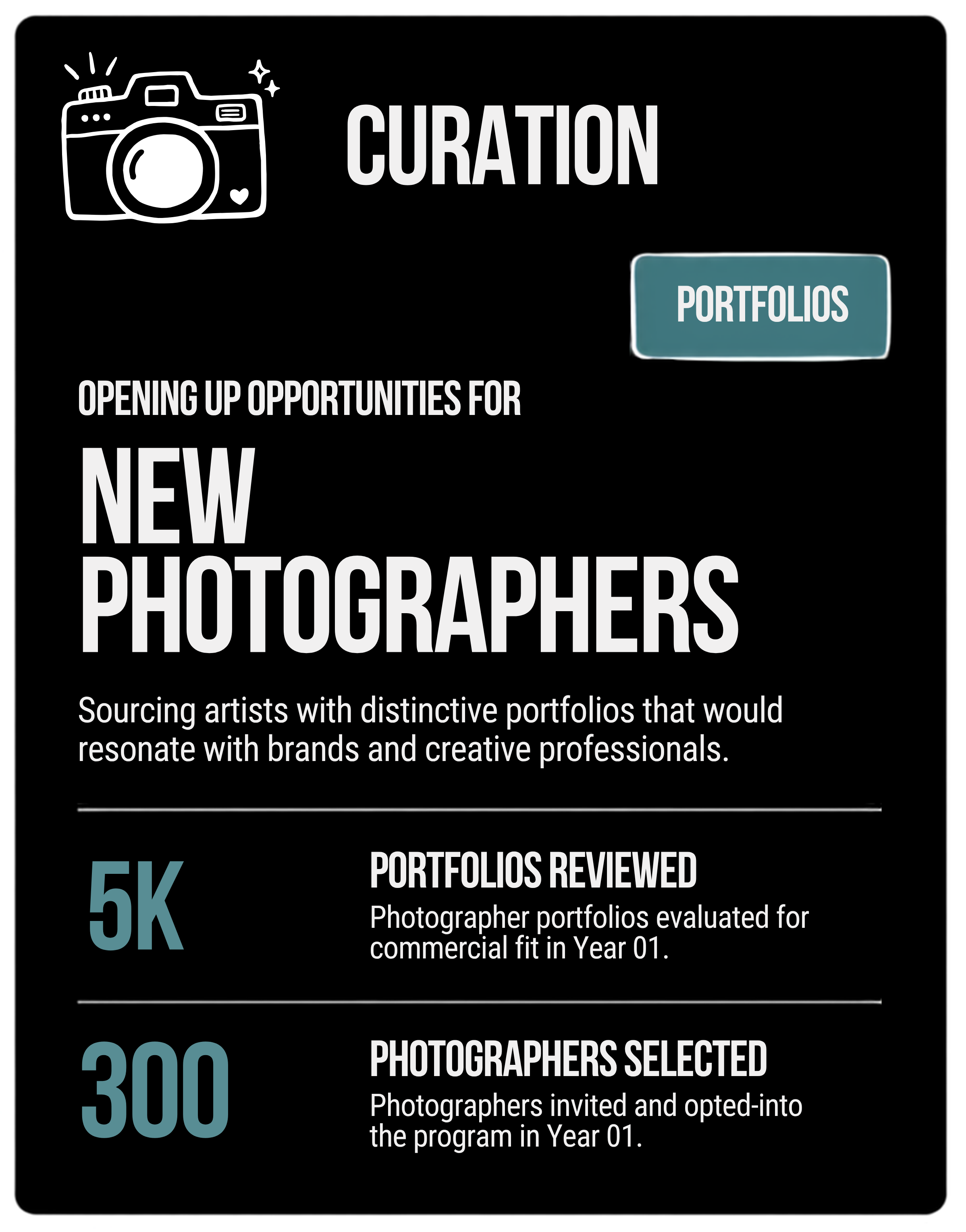
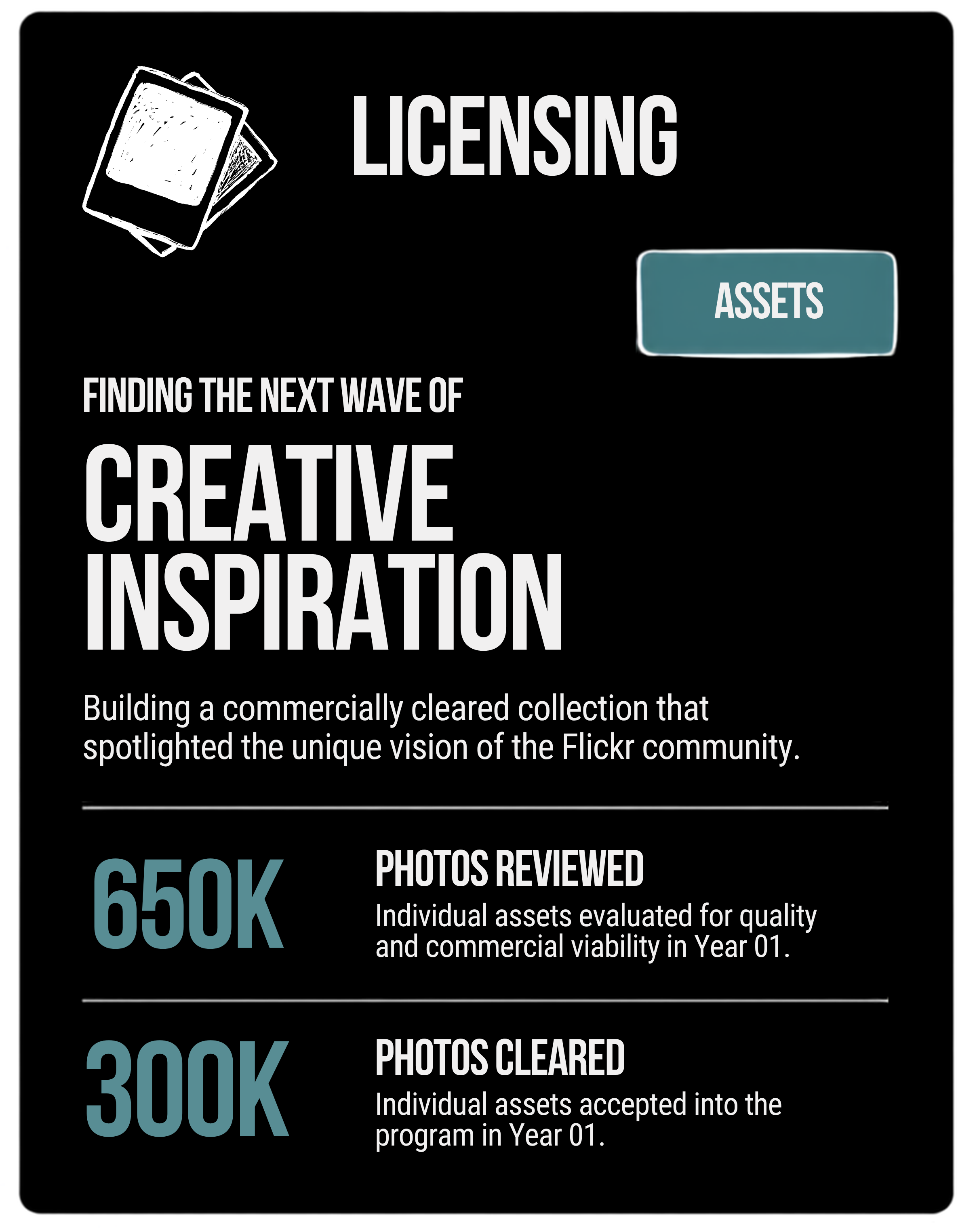
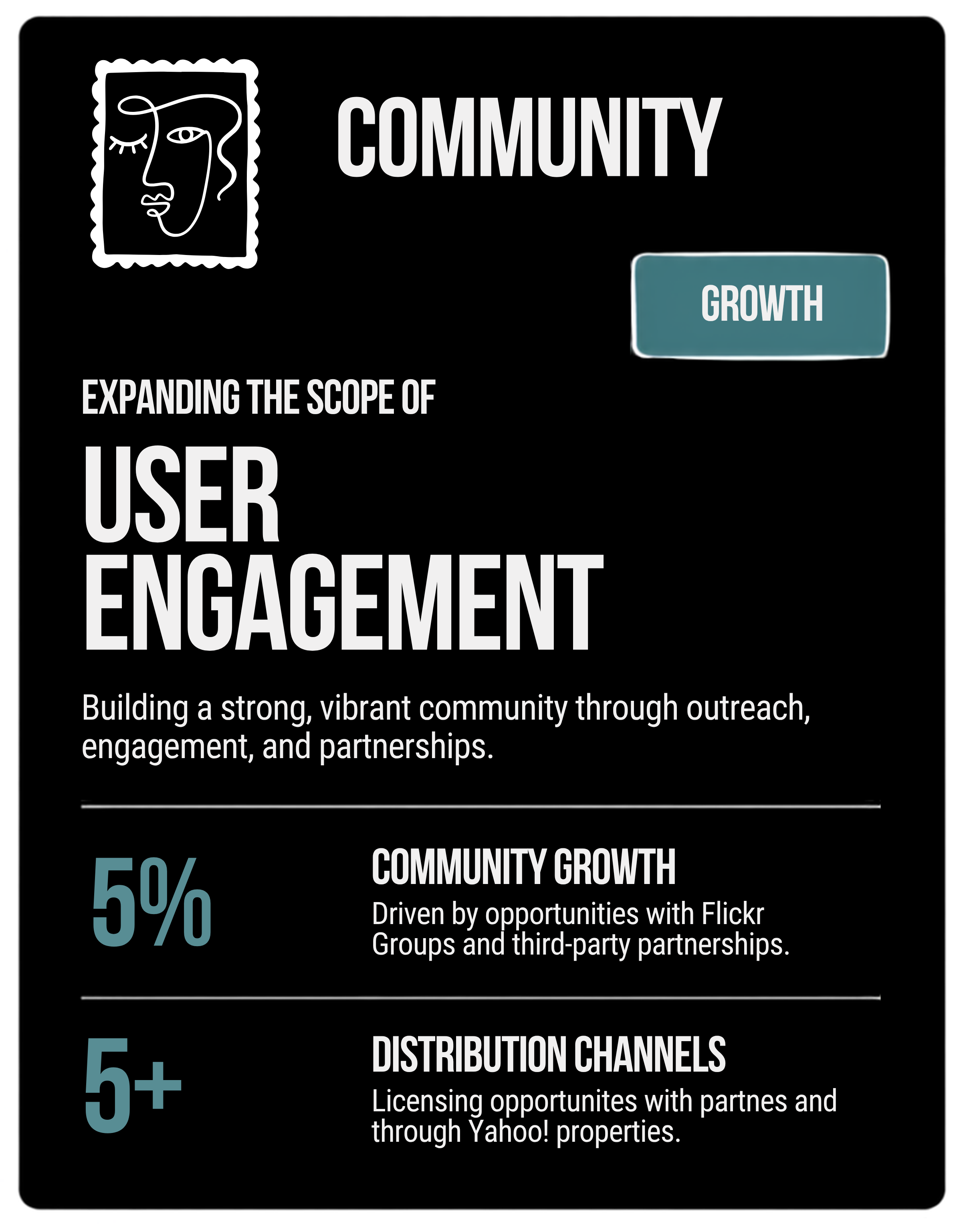
Transforming a photo-sharing platform into a commercial marketplace, a talent discovery pipeline, and a community growth engine by end of year 01.
The first year delivered three programs that had no precedent inside the organization, each requiring its own infrastructure, resource model, and set of external relationships. The Marketplace gave the creative community a commercial channel that had not previously been available. Events and initiatives like Flickr 20 Under 20 established Flickr as a place where emerging talent could be discovered rather than simply hosted. Partnerships with Yahoo and external brands extended the community's work well beyond Flickr itself.
Curation, content, and community were the infrastructure that made it possible.